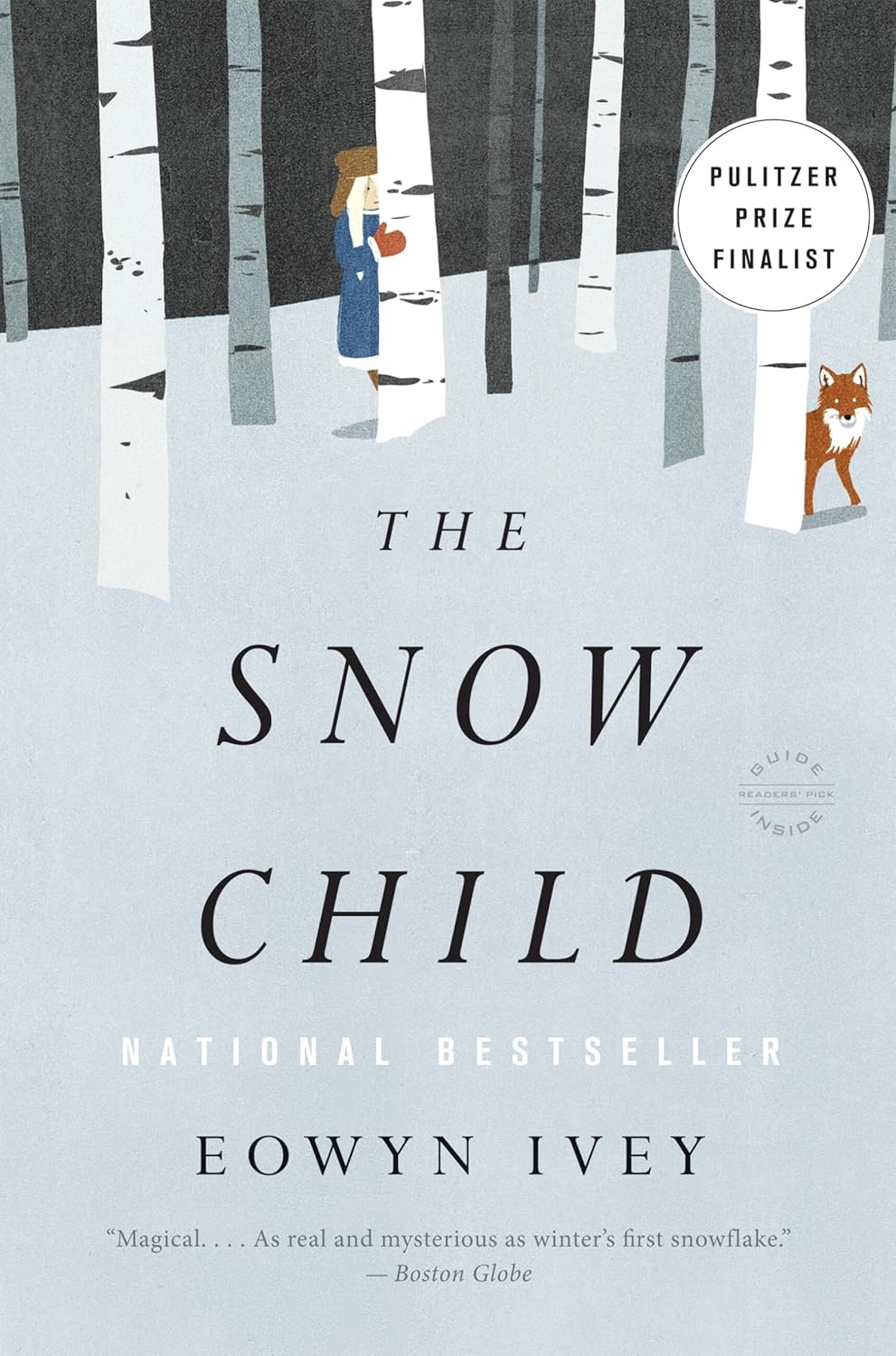
Book Details
- Written by Eowyn Ivey
- Published February 1, 2012
- Publisher: Back Bay Books, Little, Brown and Company
- Finalist for the 2013 Pulitzer Prize for Fiction
- Historical Fiction/Literary Fiction/Magical Realism
Back Cover Synopsis (via goodreads.com)
Alaska, 1920: a brutal place to homestead, and especially tough for recent arrivals Jack and Mabel. Childless, they are drifting apart–he breaking under the weight of the work of the farm; she crumbling from loneliness and despair. In a moment of levity during the season’s first snowfall, they build a child out of snow. The next morning the snow child is gone–but they glimpse a young, blonde-haired girl running through the trees. This little girl, who calls herself Faina, seems to be a child of the woods. She hunts with a red fox at her side, skims lightly across the snow, and somehow survives alone in the Alaskan wilderness. As Jack and Mabel struggle to understand this child who could have stepped from the pages of a fairy tale, they come to love her as their own daughter. But in this beautiful, violent place things are rarely as they appear, and what they eventually learn about Faina will transform all of them.
My Thoughts on this Book
A good book always leaves me wanting more, makes me reach for a new book on my bookshelf, and keeps me thinking about the great story I just finished even as I delve into a new reading adventure. That was the case with The Snow Child by Eowyn Ivey and the reason why I am here now writing about this wonderful book.
I started reading this book on December 30, 2024 and knew immediately that it was a book I would enjoy. From the opening excerpt by Arthur Ransome that frames part one of the book all the way to the final words in the epilogue which I read on January 17, 2025, I was raptured.
Then, I kept thinking to myself why did I like this book so much?
It was this question that led the aspiring writer in me to think it might be a good idea to explore this question and try to capture what it was about this book that captured me. I don’t know if that makes this post a type of book report, case study, or book review but whatever it can be categorized as I am interested in seeing where it goes.
Books I want to read because of this book:
- Winter Solstice – Rosamunde Pilcher
- The Frozen River – Ariel Lawhon
- Black Woods, Blue Sky – Eowyn Ivey
- To the Bright Edge of the World – Eowyn Ivey
WARNING:
If you have not read this book and don’t wish to have the story spoiled please turn away now
Successful Story Elements
The following are some story elements I greatly enjoyed and which I believe made this book a successful story.
- Setting: Otherwise known as the sense of time and place.
Through this story it is so clear that Eowyn Ivey has a deep love and connection with Alaska. The detailed descriptions and inclusion of the varied wildlife, plant life, topography, weather, and Alaskan lifestyle are remarkable.
Through Mabel, we see the beauty in the land. The delicate snow, the powerful rivers. Jack shows us the brutal work it takes to survive in this harsh environment. His long and freezing days depicted in the first half of the book seem very true to life. And through Garrett and Faina we get a glimpse of what it means to hunt in order to survive. Each character brings something to the story and shows us the same place but from a slightly different angle.
“She could not fathom the hexagonal miracle of snowflakes formed from clouds, crystallized fern and feather that tumble down to light on a coat sleeve, white stars melting even as they strike. How did such force and beauty come to be in something so small and fleeting and unknowable? You did not have to understand miracles to believe in them, and in fact Mabel had come to suspect the opposite. To believe, perhaps you had to cease looking for explanations and instead hold the little thing in your hands as long as you were able before it slipped like water between your fingers.”
- Fairy Tale Elements
This is what gives the story its magical realism effect. Throughout the story I kept thinking about Frosty the Snowman, about Elsa from Frozen, and wondered about the Russian fairy tale referenced in the book. Faina is such a captivating character. She doesn’t seem quite real yet at the same time we keep hoping that she is. She is etherial and spritely, like a physical embodiment of the spirit of winter itself.
- Story Structure – A story told in three parts
There is a clear story structure with a beginning, middle, and end. Each section is framed by a little story excerpt from versions of the snow child fairy tale that progress and foreshadow what is to come in that section of the book.
Aside from the overarching structure there is a lot of mirroring that happens between the characters that adds to the storytelling structure. For instance Mabel and Jack start off from a particular point of view – Jack working the farm and Mabel staying in the cabin almost feeling sorry for herself. By part two, after Jack’s back injury, the couple basically switch places. Jack has to stay indoors recovering and feeling shame while Mabel (with help from friends) tends to the farm.
There is also character foiling happening between Faina and Garret. For part of the book she is Jack and Mabel’s autumn and winter child and Garret their spring and summer child. The two share many similarities but most obvious is their love of nature and skill at hunting.
Also the two couples (Jack/Mabel and Garrett/Faina) have a connection. They reflect each other in many ways.
“The same traits that as a young woman had made her so alluring now made her seem unwell.”
While this quote is in reference to Mabel it can also be applied to Faina given that in the end it is her very essence as a snow child that is her undoing.
- Winter Theme/Motif
There are so many ways winter works in this story. Of course it is connected to the snow child herself and how she came to be but also winter has a deep connection to Jack and Mabel being in the winter to their life. Winter as grief – overcoming life’s losses and hardships. Alaska as a place with quintessential winters. Winter as a vehicle for describing the brutality and beauty of life.
- Building Suspense
Because we know about four potential endings to the actual fairy tale (as told in this book) a sense of suspense is built. All of the endings result in the vanishing or death of the snow child but in this book itself another possibility is suggested:
“What a tragic tale! Why these stories for children always turn out so dreadfully is beyond me. I think if I ever tell it to my grandchildren, I will change the ending and have everyone live happily ever after. We are allowed to do that, are we not Mabel? To invent our own ending and choose joy over sorrow?”
This gives the reader hope and creates a sense of suspense making the story a page turner. Will the story end the way the fair tales did – dreadfully, or will these characters have a happy ending? Are these characters living out a fairy tale of sorts or are they “real” and therefore exempt from the sad ending?
In the end it seems to be a blend of both fantasy and reality especially since Faina ends up having a child herself. Proof in a sense that she was real despite having seemingly melted away one feverish night.
In Conclusion
There is so much more I could say about each of these individual points and others I did not mention but in the interest of not going on forever I will cap it off here. Hopefully this provides some food for thought. As always, if you are interested, I would love to hear what you think in the comments section below.
xoxo,
Angelica Sophia
 Angelica Sophia
Leave a comment